Slamdance 2026: Interview with The Bulldogs Filmmakers Noah Dixon and Ori Segev
The directors talk about documenting the people of East Palestine, Ohio after the devastating train derailment in 2023

The 2026 Slamdance Film Festival takes place in Los Angeles, California from February 19-25. Those who can’t attend in person can watch titles from the festival online between February 24 and March 6, 2026 on the Slamdance Channel.
For Noah Dixon and Ori Segev, their latest project happened unexpectedly. The duo are co-founders of Loose Films, a production company from Columbus, Ohio, and in 2021 premiered their debut feature Poser at the Tribeca Film Festival. A thriller set in Columbus’ indie music scene about a young woman’s obsession with a local musician, Poser was well-received by critics and established both directors as up and coming talents in American indie filmmaking.
Almost two years later, in February 2023, news broke of a train derailment in the small, rural Ohio town of East Palestine, with a population under 5,000. The train contained toxic chemicals from the company Norfolk Southern and, after the surrounding areas of the accident were evacuated, authorities burnt over a million pounds of vinyl chloride from the wreck (a move the head of the National Transit and Safety Board called unnecessary). Days later, the government allowed residents to return with assertions that the air and water were safe, a claim many people still don’t believe.
Dixon and Segev, who live several hours from East Palestine, decided to make their next project a documentary about the town in the months after the crash. Set over a one year period, their new feature The Bulldogs follows several people from East Palestine starting in autumn 2023, long after the media stopped regularly covering the town. Subjects include local hairdresser Kay Biegenwald, pizza shop owner John Cozza, high school band members Keller and Tristan, football coach Michael Demster, and Rick Tsai, a chiropractor who runs for Congress after speaking out on the environmental destruction caused by the derailment.
The Bulldogs is Dixon and Segev’s first documentary, and while it’s completely different from Poser, the two films share an interest in regional subcultures and the eccentric personalities within them. Instead of chronicling the story around the accident and the bungled response by the government and Norfolk Southern, the film stays firmly within the city and keeps its focus on the residents. It’s a small-scale approach that matches the scale of the production, with Dixon also handling editing duties while Segev is credited as director of photography.
But Dixon and Segev’s ambitions with The Bulldogs are far from small. Shooting in Scope with deliberately framed compositions instead of relying on handheld cameras, the film elevates its subjects to something more cinematic as they try to return to a sense of normalcy despite being at the mercy of political and economic forces beyond their control. And while some of the residents don’t bother with politics, a visit in 2024 by Joe Biden exposes how the divisive and volatile nature of US politics has taken over the town through a tense confrontation between pro-Trump and pro-Palestine demonstrators.
Before The Bulldogs had its world premiere at the Slamdance Film Festival, I spoke to Dixon and Segev about their new film. The Bulldogs is currently seeking North American distribution.
Since you’re both in Ohio and you’re not far from East Palestine, before the derailment, did you have a connection to the town? What was your perception of East Palestine prior to the derailment?
Noah Dixon: I don’t think we heard of East Palestine specifically. I grew up in Ohio, and then Ori moved to Ohio, and we have lived and worked in Ohio. So we have always been aware of the kind of different perceptions of where we live, whether it’s rural Ohio or Columbus. This is our first documentary, and I think before the derailment we didn’t know much about East Palestine until it was in the news. So much happened.
Ori Segev: Just exploring Ohio, I have driven through a ton of small towns. And my girlfriend is about 30 minutes away from East Palestine, so even before [the derailment] I’d spent some time in that area.
As you’re watching all of this unfold in the news, at what point did the two of you decide to go in, document East Palestine, and ultimately commit several years of your lives to this project?
Ori Segev: I don’t know if, when you start a project, especially a documentary versus a narrative, you know you’re going to be spending that much time. I think we thought, you know, it’s right in our backyard, we’re close, we have this connection to Ohio. Why don’t we go there? [Let’s see] what we can make and who we meet. I think it was very early on, after the first couple of shoots, that this was something we were really passionate about and wanted to continue doing. But sometimes, like on that initial jump, you’re just going for it.
Noah Dixon: Being in a place like Ohio, it’s not like there are many huge, national news stories that happen. I think the conversations we had as it was happening was about how this kind of stuff unfortunately happens often. What usually happens is the news and media will come in for a short period of time and then leave. I think because we knew that, and we lived not too far away, the conversations that we had with our producers were wondering what kind of story we could tell over time. [Let’s] check in with these residents, approach it differently than investigative journalism, and approach it with more of an observational style of really sitting with the residents.
You did receive support from the state of Ohio for this film. Given how charged the situation was, did you have to change your approach to asking them for support? Were you concerned there might be pushback? Obviously, the government might be a little sensitive to supporting something like this.
Noah Dixon: Surprisingly, no. I think they didn’t really even know our approach from the beginning. We put a lot of work into the grant application and what it was so early on in the process. Like Ori said, I think even in those early stages we didn’t exactly know what the direction of the film would be, or what the end product would be. But with the Ohio Humanities Council and the Greater Columbus Arts Council, we’re really appreciative of their support early on.
That question extends to the residents of East Palestine as well. In your interviews with the townspeople, there’s animosity towards the extra attention and media presence. How did you two introduce yourself to that community and get people to participate in your film?
Ori Segev: I think it was important for us to be seen around the town so that people kind of knew us. We started by filming with the football team, which is such a community event. You can meet a lot of people in town just by being around at a football game. People get to know you. And we would eat at the local diner. It’s such a small town that, if you’re outside with a camera and not at these mile marker points in time where the rest of the media is, people recognize you. It’s a lot easier to approach people and talk to them if they’ve seen you around.
Noah Dixon: I think also, because we weren’t rushing for some news story, we were able to spend time with and without the camera. We would go to the Moose Lodge without the camera and hang out with people. We would go up almost every month and spend a considerable amount of time there. I think that, because we knew that we wanted to continue the story over a long period of time, we approached it in a way that didn’t always feel rushed, and really wanted to get to know the residents on and off camera.
With regards to the teenagers you interviewed, did you realize at some point you ended up only focusing on band members in the high school?
Ori Segev: Well, I was never in band but Noah was. We were definitely comfortable there.
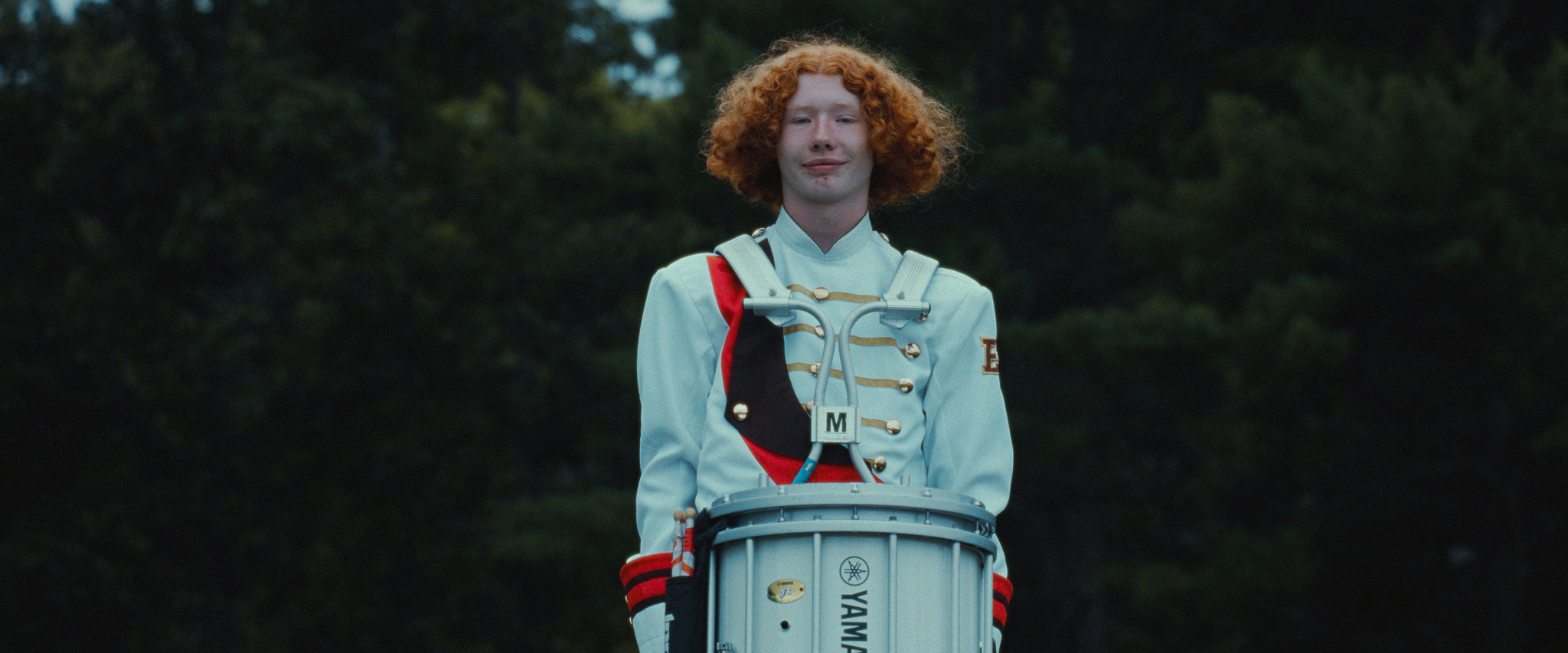
Noah Dixon: It’s so funny because our producer Drew Johnson played football in high school and college, so he was the one who first connected us with the football team. And he was in his element. You could see this old football side coming out of him, whereas Ori and I felt so out of place. And early on, Keller, the red headed snare drum and cymbal player, was so great to talk to. We knew we had to film more with him and Tristan, the percussionist. They were giving us such great material that we wanted to continue [working with them].
Ori Segev: Tristan joined us in Columbus for a little bit. He wants to be a filmmaker and he got to work on the project.
Noah Dixon: He did some assistant editing work, which was great.
With a subject like this, there are different ways you can approach it because it’s like a microcosm of so many things going on in America right now. You chose an approach that’s grounded. You stay within East Palestine and only focus on the community and residents. I wanted to know why you chose this direction, or why you wanted to approach it from this perspective.
Noah Dixon: I think there are a number of answers. I’m curious what you say, Ori. There’s a part of me that knew there were other approaches being approached in that way. There are politicians and journalists and, whether we agreed or disagreed with them, there was a spectrum of attention that we knew was happening. And we come from a narrative film background. Like I said, this is our first documentary film, but it’s something that we always wanted to do. I think we’ve always leaned towards stories that have a really strong visual style. I personally had been wanting to make a documentary that’s a portrait of the place that I grew up in, not East Palestine but Ohio and the Midwest. So I think that it felt right for our voices in some ways, even though it was a new challenge working on a documentary from a background in narrative filmmaking. We knew we wanted to focus on capturing the beauty of a place and really understand the locations. We wanted to set up frames that allowed our residents to come through, both in a visual way as well as their personalities. It’s a tough question because there are so many different conversations that went into it, but from my perspective that’s one reason why we chose to approach it that way.
Ori Segev: I feel like, at least in the rhythm of the movie, it feels a little bit more like you’re in the town as all of this is unfolding by how we place the camera and let residents talk to each other. It didn’t feel like we were trying to insert our agenda too much. We let everybody speak for themselves, and I think that’s why residents liked talking to us because it didn’t feel like we were pushing anything.
Obviously, the politics of the situation are in your film, but with Biden’s visit to East Palestine politics take a central focus with the pro-Trump and pro-Palestine protests happening in town. How did you approach weaving the political elements into your film? Since you didn’t want to insert an agenda, what do you want viewers to take away from how you’re portraying politics in your film?
Noah Dixon: You said it earlier. I think we felt that it was a strange kind of cross section or microcosm of what was happening in this very small, rural town. And what’s weird is how it’s changed, because we were filming mostly in 2023 and so much has politically evolved since then. Our goal was to show the humanity that is behind this corporate failure that led to this environmental disaster. Not to make it too much about the disaster itself, but more so about the impact on the working class people that it [impacts]. From the very beginning, that was what we wanted to focus on. I think that everybody can identify with what’s out of your control. There are things that happen in politics and the economy, all of these things that Americans are dealing with that are out of their control. So how do we show the humanity? [It can be] through humorous moments, or sad moments, or capturing the beauty of humanity in spite of these things that are out of our control.
You’ve mentioned that this was your first documentary. Was there a stumbling block or hurdle that you didn’t expect in dealing with the documentary format compared to a narrative film?
Ori Segev: Honestly, our approach was hard. I think Noah deserves a lot of credit for really pushing us to not move the camera. Sometimes we’d enter a person’s space, we’d have five minutes to set up, and then we’re committing to that frame for 30 minutes. And my mind would start wandering, like, “Oh my God, there’s something way better over there.” Every time we would look back through the footage, if we did move the camera it wouldn’t edit the right way, so that was a challenge.
Noah Dixon: I think we are used to more control coming from a narrative background, and that was something we had to give up a lot of. We never knew what we were going to get. We would set up the camera, find the frame, have the conversations, and we never knew what we’d come away with. Some days were definitely harder than others, but I think that we grew a lot from the whole process, and I’m really glad that we did it. But it took a lot of time.
Ori Segev: The Biden day that you mentioned, we didn’t know any of that was happening. We were expecting to maybe get a shot of Biden coming through town, or whatever it might have been, and had no idea of the protests. As soon as we entered the town we were like, “We have to figure out how to shoot this.”
Was there a point where you considered widening the scope? I realized partway through the film that you’re not interviewing any authority figures. You don’t interview anyone in the government, you’re not interviewing scientists, nor anyone from Norfolk Southern. Was that ever a consideration, or were you only focused on just keeping it in East Palestine with the residents?
Ori Segev: We talked about it. Early on, it felt like there were other people that might be making stories that are science focused. And it felt more like, as we met the residents and as we were in the town, this was more focused on the community itself. I think we tried [to widen the scope] with the news footage. The way we showed that stuff, it was more like the rhythm of this is the year, this is the news cycle as you would watch it in clips. It didn’t feel like we needed to add so much of that.
You’re not showing a direct feed of the news footage. You’re filming the clips on a TV screen, so there’s a distance from it.
Ori Segev: It was one of those things where we had a bunch of different versions of how that looked. It took us a while to figure out what felt natural. I think our initial plan was that, if we were in a restaurant and the news would be on TV, we could capture that. But it wasn’t realistic for that to happen as we were filming. We took all of the clips we had, ran them through an old TV, and reshot them on that.
There’s a tension throughout the film between the townspeople and the authorities. The authorities insist that everything is fine and safe, but the townspeople don’t believe it. When you were in East Palestine, how did you both personally feel about the town’s safety or water and air quality?
Noah Dixon: We definitely took precautions. We drank bottled water. Again, we weren’t like the journalists that were going right as it happened. We waited for some time. Something we had talked about every time we went up there was about the safest way to do it, or being overly cautious. It’s one of those things that’s reflective of what happened in the town in that time goes on and you get more and more comfortable. We were always cautious of it but that’s what we were seeing in the town. Fortunately for us, we live in Columbus which is a few hours away, but it was something that we were always discussing as we were making the drive up there each month.
Ori Segev: I think it’s hard to know. When you’re there, there’s different information every single day that people are getting. I think people did want some sort of level of transparency, like, “Hey, this is what’s happening, here’s the best way to deal with it.” That was something that didn’t totally happen.
I wanted to ask about the style of your film. Ori, you’re the director of photography, and there’s difficulty in having a locked down camera for documentaries. How did you both develop the style and visual language when you started filming?
Ori Segev: I think my natural [instinct] in situations where you can’t control them is to have as many options as possible. I think it was a lesson in patience. As we were coming back from every trip, and Noah was editing, we’d be able to see how shooting this way was working. I think that helped so much because, at a certain point, you’ve been shooting for 20 minutes. You know you have a section that you’re going to use, so maybe we push in a little bit so we have a cutting point, or you start editing a little bit while you’re there and get some pickups. As we realized how well it was working, it was nice to continue filming because we [came back] and had an idea of what this section in the film should feel like. Sometimes we’d come back from a shoot and [realize] we didn’t really get anything, and then we’d have an amazing next day.
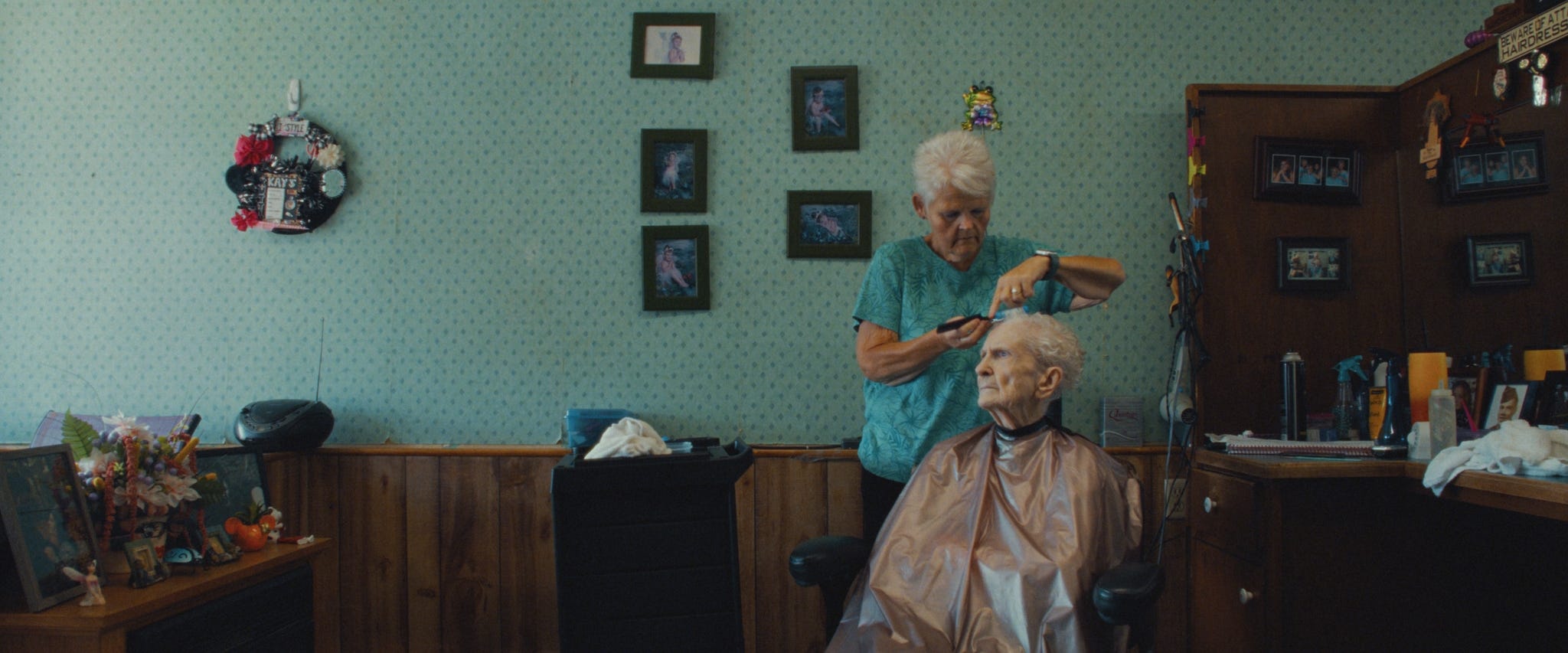
Noah Dixon: Early on, we went into Kay’s hair salon and she had this great wallpaper and natural light coming in. We literally put the camera up on a tripod and it looked like this beautiful, Wes Anderson kind of thing. Every situation wasn’t like that, but we were fortunate to have this visual moment early on that felt like a North Star we were able to point to. That felt like an important moment where we really liked this visually, so let’s try to stay on that visual path.
I also wanted to ask about the score. You bookend the film with montages that have a sweeping, cinematic quality to them with the soundtrack. How did you work with your composers on scoring the film, and why did you want to bookend the film with these montages?
Noah Dixon: We’re really fortunate. We were able to work with our composers that we’ve worked with on our narrative projects, Adam Robl and Shawn Sutta. As creative collaborators from working on the narrative projects, we sync together in ways that really help. Their music helped influence the edit a lot of the time. I think a lot of times filmmakers will have a picture lock cut and then work with their composers, whereas with them we’re working from the beginning and finding the edit through working with them. That’s how we’ve worked, both in narratives and on this film.
Ori Segev: It’s very fluid. There’s a lot of back and forth happening.
Noah Dixon: Even with those sweeping news sequences, it’s not like we found that and then sent it to them to edit. They were writing music that really helped with that, and we were continuously building that out. I think that process really helped with this specifically.
Ori Segev: With the fireworks in the ending montage, we sort of knew the film would end there. Just from people in the town talking about the Fourth of July, it felt like the right place [to end]. It’s the whole community together, and it felt like a nice place to leave the town.
The film doesn’t end on a positive note with regards to the derailment. There’s no accountability for those responsible or justice for the victims. At the same time, that closing montage with the fireworks does add something hopeful. I’m a pretty cynical person myself and it might sound silly to ask such a broad question, but where do you see hope in a situation like this?
Noah Dixon: With the last song [in the film], it balances this beautiful hopefulness with an undertone of melancholy. I don’t know how intentional it was, or how much we found it in the edit, but I love that the ending feels that way. There is this beautiful togetherness of community and this symbolism of what America maybe should be or wants to be. I think that all of those things together felt like trying to toe that line between beauty and hope, but I think they’re similar to what you’re saying. I think that there is a lot of cynicism, or a melancholy feeling as well, that I think a lot of people feel many times in their lives. I think the goal with the ending was to try to hit both of those feelings.
Have you shown the film to anyone in East Palestine? Have you gotten any responses yet from the subjects of your film?
Noah Dixon: We actually just went up there right before coming [to Slamdance]. We did a really small screening at the library for just a few of the [subjects]. It was nerve wracking but we got a great response. They really enjoyed watching it. Some of them, like Keller, now live as an exchange student in Brazil, so he wasn’t able to come for [the screening]. And Tristan’s at college right now, so we’re planning to do a larger screening in East Palestine soon.
Ori Segev: Honestly, watching it with them was pretty intense. We were watching it at the library in East Palestine on a projector, it was a really intimate thing. But one of the things that John Cozza said that will stick with me was when he said something along the lines of, “I didn’t want to stop watching. I wanted the movie to keep going.” That was nice. I think they really appreciated how we told the story and felt good about how we portrayed the town.
This interview has been edited and condensed for clarity.